Showing posts with label Poultry. Show all posts

Wednesday, January 26, 2011

Left-Overs - Part 2: Chicken Curry Salad

With the other half of my left-overs from the weekend (balsamic-marniated chicken breast) and various vegetables and other items I had in the pantry, I made a very quick chicken curry salad:


Ingredients:
- Cooked chicken breast, cut into 1cm cubes
- 1/2 cucumber, brunoised
- 1 large carrot, brunoised
- Handful green beans, cut on the diagonal into small pieces
- 1/4c slivered almonds
- Packet of pre-cooked barley and spices (similar to this)
- 2oz part-skim low-fat mozzarella cheese
- 1/4c plain yogurt
- 1T curry powder
- 1T lime juice
- 1t honey
- Salt and pepper to taste

Toss the first 7 ingredients together in a bowl.  Mix the yogurt, curry powder, lime juice, honey, and slat and pepper together in a small bowl and then dress the chicken salad. 

By using the leftovers and the pre-cooked barley/whole grain rice mix, you can really put this lunch together in a matter of minutes in the morning!
-

Tuesday, January 25, 2011

Left-Overs - Part 1: Pasta with Chicken and Balsamic Mustard Sauce

Over the weekend I made chicken paninis for Cillian and his running buddy, Tom.  I had bought four chicken breasts, and threw them all in the marinade of balsamic vinegar, water, chicken spice seasoning, and mustard seeds.  I cooked three of the four breasts for our sandwiches, and left one lonely breast in the marinade.  I also had some left-over cooked spagheti (dressed only with a little butter and parmesan), so here is what I made for lunch:


Ingredients:
- 1 chicken breast, marinated in balsamic, water, chicken spice seasoning, and mustard seeds
- Canola oil
- 2T shallots, finely minced
- 1/2c wine
- 1/2 - 1c chicken stock
- 1T mustard
- 1t mustard seeds
- Salt and pepper as needed
- Cooked noodles

Heat your oil in your pan.  Add the chicken breast and saute until cooked.  (You could cut your breast into bite-sized pieces before cooking, but I wanted to let it cook longer and really have the balsamic marinade get carmelized and dark, dark brown, so I left the breast whole and cut it up after it was cooked.)

Remove the cooked chicken, deglaze with wine, add shallots and cook until almost all of the liquid has evaporated.  Add the chicken stock and mustard seeds and reduce until sauce consistency.  Add mustard, salt, and pepper.

Toss noodles, chicken, and sauce.  Voila, lunch in 20 minutes (also great reheated)!

Thursday, December 30, 2010

Chicken Curry

This recipe is a slight alteration to the chicken fricassee with a curry addition.  It is not too fast, but it only takes about an hour and the curry sauce is deliciously flavorful.  I made my own chicken stock for this recipe, following the usual method, but added about five whole cloves to my herb mixture, which gave the stock a very aromatic, spicey quality that was perfect for the chicken curry and accompanying rice.

Ingredients:
- Parts of 1 whole large chicken (or you could use 4 chicken breasts), cut into 1-inch-cubes
- 4T butter 
- Medium yellow onion
- Large carrot
- Large stalk of celery
- Salt & Pepper
- 3T flour
- 1T curry powder
- 3c chicken stock
- 1c white wine
- 1/4c cream
- 2T butter

Melt 4T butter in a french oven.  When hot, saute onions, carrot, and celery.  When tender, add the chicken pieces and allow to cook for about five minutes, turning every minute until tender but not browned. 


Lower heat to very low, cover and cook chicken for another 10 minutes.  It will plump a little as it cooks, but don't let it brown.

After 10 minutes, sprinkle with flour and curry powder.  Stir to make sure the flour covers all sides of the chicken, and allow to cook for about 4 more minutes, covered.   

Pour in chicken stock and wine.  It is best if the chicken stock is hot when you add it, but if not, bring the liquid up to a very soft boil.  Cover and maintain at a slow simmer for 20 minutes.  


When chicken is cooked, remove chicken and vegetables.  I used a slotted skimmer to do this, which was perfect for the job. 

Bring to a medium boil to reduce to a sauce consistency.  Add cream and bring back to a simmer.  If necessary, season with cayenne pepper and salt. 


Serve rice, chicken and vegetable mixture, and then sauce over top.  

Bon Appetite!

Friday, December 3, 2010

Chicken and Broccoli Gratin (or a use for leftover turkey!)

This recipe is adapted from one found in the Avoca Cafe Cookbook.  You could alter it slightly (see discussion at end), to use up any left-overs still hanging around from Thanksgiving.

Ingredients:
- 2 chicken breasts
- 1 onion (red, white, or yellow)
- 2 celery stalks, chopped
- 2 carrots, chopped
- Handful of parsley sprigs
- 2 bay leaves
- 5 peppercorns
- Large head of broccoli, cut into florets
- 3/4c cream
- 1c shredded strong cheese
- 2T butter
- 2T flour
- Cyanne pepper and salt (as needed)
- 2c bread cubes, or 1 box of stuffing mix

Combine the uncooked chicken breasts, onion, celery, carrots, parsley, bay leaves, and peppercorns in a soup pot.  Add just enough cold water to cover the ingredients.  Bring to a boil and simmer until chicken is cooked, about 20 minutes.  You are basically going to cook your chicken and make a quick chicken broth here.


Remove the chicken from the pot and set aside.  Remove the vegetables and herbs and reduce until you have about 1 pint of broth. 

Meanwhile, cut up your broccoli and cooked chicken into bit-sized chunks and toss together in an oven-safe dish (no lid required).


Now, in a separate sauce pan, make a roux:  Add the butter and heat until melted, then add the flour and stir together until you get a very thick paste consistency.  Let it cook together very briefly (about 30 seconds).  Add the cream and whisk until smooth.  Bring to a very light simmer and let it reduce for about 2 minutes.  Add the cheese and whisk to smooth.  Pour the cream mixture into the pot with the broth and wisk together.  You may need to simmer this to reduce and thicken the consistency of the sauce.  Add a pinch of cyanne pepper and salt if needed. 


Pour over the chicken and broccoli.  


Cover with stuffing mix, pressing it down lightly into the liquid so that it will absorb while it cooks.

Bake at 350 degrees for about 15-20 minutes, until bubbly.  Serve hot.


To alter this recipe to use up your Thanksgiving left-overs, replace the chicken with cooked turkey.  Replace the vegetables, herb, and water process with pre-made stock.  You will likely need to reduce it somewhat, but it should definitely be hot before you whisk in your cream mixture.  You could even add some left-over gravy to the sauce and reduce the amount of cheese.  Replace the box of stuffing mix with the real thing.  Now you have a great Turkey left-over meal!

Thursday, November 11, 2010

Thai Chicken and Coconut Rice Soup

One thing that the Irish do surprisingly well is soups.  They are usually smooth, brothy, slightly creamy soups served as a starter.  I am now re-committed to trying to make savory wonderful soups.  This soup from last night is chunkier, but the broth is wonderful and I might try to recreate the flavors just in a smooth broth next time.  It has just a slight kick of spice from the ginger and chili pepper, and would be a great subsitute for the traditional chicken noodle if you were feeling under the weather.

Ingredients:
- 1c rice (I used sushi-style short grain, but any kind is okay)
- 2 pints (or more) chicken stock
- 1 chicken breast, cooked and cut into small pieces
- 2T freshly grated ginger
- 1T freshly grated red chili pepper
- 2t fish oil
- Zest and juice of 2 limes
- 1 can light coconut milk
- 1T lemongrass (I buy the kind in the jar, so there's no messing around with boiling water)
- 2 heads of bok choi, cleaned and thinly sliced
- Cilantro for garnish, if desired 

Combine the rice with 1c of the coconut milk, 1c of the chicken stock, and about 1t salt and cook.

Meanwhile, combine the remaining chicken stock, ginger, chili, fish oil, lime zest and juice, and lemongrass and bring to a simmer over medium heat.  When hot, add the bok choi and chicken.  Allow this to cook for about two minutes until the bok choi is cooked.  Add the cooked coconut rice.  Add the coconut milk a little at a time until it is the desired thickness.  I found I didn't need the whole can, and adding too much can make your soup overly sweet and sticky, so go slow.  Add salt if desired.

Serve with a garnish of cilantro leaves. 


Bon appetite!

Wednesday, October 27, 2010

Homemade Chicken Noodle Soup

Hopefully everyone is staying healthy during the cold season this year.  Just in case you start to feel a little under the weather, here is an easy recipe for homemade chicken noodle soup.

Ingredients:
- 8c homemade chicken stock
- 1T canola oil
- Salt and pepper
- 1t dried oregano
- 2 large carrots, peeled and diced
- 1 small white or yellow onion, diced
- 3 ribs celery, diced
- 1 medium russet potato, peeled and diced
- 1c riso pasta (looks like rice, but is in the pasta aisle)
- 2 chicken legs and thighs, cooked and cut up

Heat your oil in a soup pot.  When it is hot, add your onion, carrots, and celery.  Cook until just starting to soften. 

Add your riso and oregano.  (I use the riso as an alternative to the more traditional larger noodles.  I think it works well with the diced up vegetables, but feel free to substitute any kind of noodles that you like.) 


Add the chicken stock, potato, and chicken let simmer for about 20 minutes, until the rice and potato are fully cooked.  You can keep it on the stove longer if needed, just turn the heat down.

Serve hot!


Wednesday, October 20, 2010

Pumpkin Chili

With fall and winter fast approaching, I decided to make chili over the weekend.  I also was persuaded to try to incorporate pumpking into my chili recipe.  I have to admit the results were mixed.  I will post my standard chili recipe soon, and still have yet to find a better version.

Ingredients:
- 4 garlic cloves, finely minced
- 1 jalapeno, finely minced
- 1 large onion, diced
- 2 green peppers, diced
- 4T chili powder
- 1T cumin
- 2t dried oregano
- 8 cups chicken stock
- 1T worscestershire sauce
- 2T dijon mustard
- Large can diced tomatos, undrained
- 1 package dried great northern beans, cooked
- 2 chicken breasts, cooked and shredded

Heat 1T vegetable oil in a large stock pot over medium heat.  When hot, add garlic, jalapeno, onion, and green pepper.  Cook until soft, about 5 minutes. 

Add chili powder, cumin, and oregano.  Cook an additional 2 minutes.

Add chicken stock, worcestershire, dijon, pumpkin, tomatos, and beans.  Bring to a boil and gently simmer for about 20 minutes.  Add the chicken breasts.  You can keep the chili hot over low heat, covered, as long as needed until you're ready to eat.

Serve with shredded cheddar cheese, sour cream, and corn bread.


Note:  For my standard recipe, omit the pumpkin and add 1 jar chili sauce, found in near the katchup in the grocery.

Sunday, October 17, 2010

Homemade Chicken Stock

I am convinced that homemade chicken stock is one of the best kept secrets in cooking.  I have to admit that I am a recent convert.  When I first learned how to debone a chicken, I really did not believe that I would have the time and energy to make my own stock on a regular basis.  Now I make stock nearly every weekend.  My husband calls it the "magic stock" because all of my recipes are so much improved just by using it.  The best part, is that it is extremely simple. 

Stock is basically made of just raw bones and water.  The other ingredients are for added savory flavor.  If you have tried to make stock out of cooked bones (like a roast chicken carcass), you were probably disappointed by the result.  This is because cooked chicken bones no longer contain collagen, the ingredient needed to make stock.  For those chemistry buffs out there - stock is made by covering bones with collagen in them with cold water, then bringing to a boil to convert the collagen to gelatin.  It is the presence of gelatin in stock that allows the flavors to linger in your mouth when you're eating.  It also gives it a tiny bit of body.  Not much, but just enough to notice.

My last post described how to debone a chicken to give you the bones needed for your stock.  You may be wondering where to get enough vegetable bits.  My sauces teacher advised us to keep a freezer baggie in the freezer and when you're cutting up onions, carrots, or celery, just throw the unusable ends and other bits into that bag.  Keep it in the freezer until you're ready to make stock.  Voila! 

You may also use herbs to flavor your stock.  A very classic combination is parsley stems, dried thyme, and/or a bay leaf.  You can apply the same theory from saving unuseable bits of vegetables to your herbs - just throw the woody stems or other undesirable bits into the freezer bag as you go.  You'll add great flavor to your stock with the added bonus of using all of the herbs you pay so much for at the grocery.

So, to make the stock, you will need raw bones, vegetable pieces (onion, celery, and carrot work best), and any herbs you want to use (parsley stems and a bay leaf are classics). 

- Combine everything in a stock pot and cover with enough cold water that the bones and vegetables are submerged by a couple of inches. 

- Turn on the stove top and bring the water to a boil.  Leave uncovered to gently simmer or boil very softly for several hours.  Taste your stock periodically; you will be able to tell when it is condensing and developing.  If it seems too watery after a few hours, you can turn up the heat to boil off more of the water, further condensing the stock flavors.

- When your stock is done, pour through a sieve into a bowl.  You'll notice the vegetable bits are mushy and the bones are brittle (this is because there is no collagen left in them).  Make sure to press down on your mushy vegetables and brittle bones to get all of the flavorful stock out.  Throw away the used ingredients in the strainer.

- Season your stock with a little salt and pepper to taste.  You can either use your stock right away or let cool.  If you let it cool, the fat will rise to the top and solidify.  Just skim it off when you go to use your stock. 

What could be easier?  Just leave your simmering stock on and go about your morning or afternoon.  It is really hard to screw this up.  If you over-cook it, just add a little more water to dilute.  If it isn't condensed enough, keep boiling. 

And trust me, you'll be happy you have homemade stock during the week to add that extra TLC to your meals.  Happy cooking!

Deboning a Chicken

If you haven't tried making your own chicken stock, you should definitely start!  It is very easy, and really enhances all of the dishes you make with it.  Plus you control the amount of salt you add, so you can cut your sodium intake.  Those store-bought chicken stocks use lots of salt to make up for cutting other ingredients.  I promise, it is very easy.  All you need is chicken bones and the spare clippings off of the vegetables you've used the week before. 

I like to start with a whole chicken, remove the meat and save for cooking during the week, and use the carcass and internal organs for making the stock.  This post will cover how to debone your chicken.


Step 1:  Get to know your chicken
- Take your chicken out of the plastic and look inside the opening and pull out any internal organs or the neck that are usually sold with the chicken. Orient your chicken so that you could shake its "hand" and then lay it back on its back.  Now your chicken is ready to start cutting.


Step 2:  Remove the legs
 - You are going to cut the legs off first.  Start by slicing the skin right where the leg meets the body of the chicken.  A shallow cut here should expose the hip joint.
 

- Complete the cut by continuing to cut up towards the wings, continuing to expose the hip joint.   Then turn your chicken over.  Continue your cut up around the top of the hip.  You should use the tip portion of your knife and feel your way.  Don't cut through any ribs or any bones at this point.  There is a tender meaty portion on the back of the chicken known as "the oyster."  Make sure you get this in the leg piece you are cutting off.  In the picture below you can see that I've just cut around the oyster. 


- Continue your cut down, getting all of the thigh meat.  Turn your chicken back over on his back.  At this point the leg should be mostly cut off, with just the bone holding it together.  Pull the leg back towards the back of the chicken, fully exposing the joint.  You may hear a pop as the hip dislocates.  Find the space between the two bones with the tip of your knife.  It should be easy to cut through this joint.  Now your leg is free. 

- Repeat on the other side.  

Step 3:  Remove the wings
- Next you are going to remove the wings.  First, find the very last joint on your chicken's wing.  Place the part of your knife closest to the handle on this joint and then firmly push down with the heel of your left hand.  The tip of the wing should cut off very easily.  This part of the wing has very very little meat and is best used in your stock.  Reserve these bits.


- Now bend your chicken's wing back to find the shoulder joint.  When you've found it, cut through the joint, removing the wing.

 Step 4: Remove the breasts
- To remove the breasts, start by laying your now legless and wingless chicken on its back.  Find the point of the breastbone and make a shallow slice on top of it, making sure not to cut into the bone.  


- Next cut off one of the breasts by following the rib cage down, making small slices as you go and pulling the breast meat away as you go.  This will help you get all of the meat on the breast and not on your carcass.

- Repeat on the other side.

Step 5:  Finishing
- Now that you have deboned your chicken, make sure to set aside the carcass, wing tips, and inner organs + neck for your stock.  


- You should have two legs, wings, and breasts for cooking.  I like to store my chicken pieces in a plastic bag (like the type you get in the produce department) and then inside a large Tupperware container in the fridge for use during the week.  


I like to debone my chicken(s) and get the stock going first thing Saturday or Sunday morning.  This way you'll have chicken pieces and fresh stock for the week, plus your house will smell delicious all weekend.

If you've never deboned your own chicken and made stock from scratch, I totally understand that it can be very intimidating at first.  But rest assured, after you've cut up a few chickens, you'll be able to do this in under 5 minutes easily; you will have fresh home-made stock to use, which is worlds better than the store-bought stuff; and you will save money as whole chickens are cheaper than chicken parts and stock.  It is definitely worth the effort (which is minimal)!

Thursday, September 30, 2010

Chicken Marengo

Chicken Marengo is a traditional Northern Italian dish that was supposedly first cooked after Napoleon won the Battle of Marengo, from entirely local ingredients and some brandy from Napoleon's flask.  Who knew Napoleon was eating locally and thinking globally long before it was an environmentalist slogan?

Apparently Napoleon was quite supersticious because he named one of his favorite horses Marengo and also ordered his personal chef to cook Chicken Marengo at each battle thereafter.  The Horse Marengo is believed to be the one in the iconic Napoleon portrait.  Marengo was captured at Waterloo, but lived in England until he died at age 38.  His skeleton is still on display at the National Army Museum in London.


Chicken Marengo:
- Whole chicken, in parts, seasoned with salt and pepper
- 4T olive oil
- Yellow onion, thinly sliced
- 1/2 cup wine (white or red)
- 1 cup chicken stock
- 1 bay leaf
- 5 sprigs of fresh thyme (can remove the leaves or put in the whole sprigs)
- Handfull of parsley sprigs
- 2 garlic cloves, crushed
- Can of diced tomatos, with italian spices, undrained
- Juice of one lemon
- 1/4c (1/2 stick) butter
- 1 cup olives (kalamata or black)
- Brandy (optional)

Heat the olive oil over medium heat in a soup pot.  A Le Creuset or similar is good for this dish.  Gently saute the onions until cooked and starting to color slightly.  When cooked, remove from the pot and reserve.

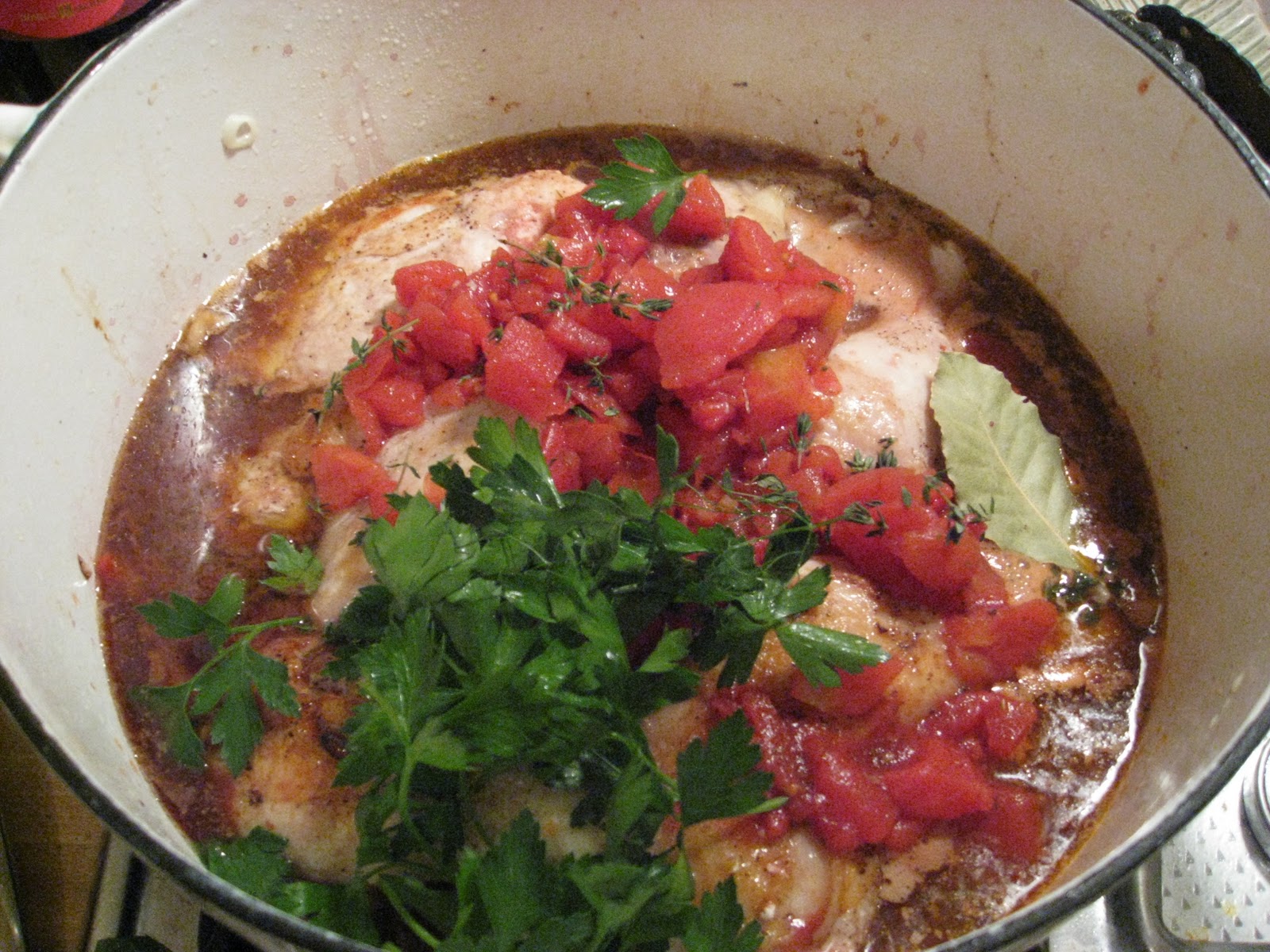
Add the chicken parts and brown on all sides.  When the chicken is browned, add the wine, stock, bay leaf, thyme, parsley garlic, and tomatos (with juice).  Bring to a boil and then reduce to a simmer.  Cover and simmer until chicken is cooked and tender, about 1 hour.


The recipe calls for dry white wine, but I only had red.  Given that this recipe was born out of scavenging for local ingredients easily obtained, I decided to go with the red instead of making a special trip out to the store for white.  It turned out great.  I will keep you posted on how it turns out when I make it with white.
While the chicken is cooking, put the onions and 1 cup black olives in a serving caserole dish.  If desired, you can add mushrooms to the onions and olives.  When the chicken is cooked, add it to the onions and olives in the caserole dish.  At this point, you can pour a chigger of brandy over the chicken.  I skipped this step because I didn't have any brandy.


Strain the solids out of the sauce, bring to a boil and reduce by about half.  Once reduced, add the lemon juice and whisk in butter one tablespoon at a time.  Season if needed.  Pour the finished sauce over the chicken and vegetables and heat through in oven at 350 degrees if needed.

Serve with rice or potatos.


Bon Appetite!